Source:                       www.jubileecampaign.org

Date:                           August 15, 2026


This is the fourth installment of our email reporting on our new publication, Stolen Girls, which seeks to document patterns of forced conversion, abduction, child marriage, and sexual violence affecting minority girls in Pakistan, and to highlight the legal gaps and institutional failures that allow these abuses to continue. You can click the links to view our previous emails which discuss the geographic scope of cases, the age distribution of victims, and judicial precedents.

Musarrat


Her name was Musarrat. At 15 years old on one evening in autumn, she was abducted just outside of the Shama Cinema in Sahiwal, Punjab, by a man named Syed Safdar Hussain. The teenager had a bright future ahead, as she had already proven herself to be a talented vocalist. Instead, in the span of just three days, the entire trajectory of her life was turned on its head; she became a wife.


Musarrat's father tried everything within his power to rescue the girl from the clutches of a forced child marriage, even successfully removing Musarrat from Hussain's residence and bringing her back with him to their home. Yet, Hussain, claiming to be the rightful husband of Musarrat and therefore entitled custody of her, filed a claim against his 'father-in-law" for kidnapping the girl. Musarrat, Hussain additionally alleged, was 18 years of age and willingly chosen to marry him.


Against all reason and even the slightest concern for the welfare of a young girl, a High Court judge concluded in favor of Hussain, effectively sending her back to live with her abuser, under one roof, as a 'wife' at just 15 years old. Musarrat's father attempted to file an appeal on the grounds that, as a minor, his daughter should have been removed from her underage marriage and returned to her family. Nevertheless, the Supreme Court judged that Musarrat could legally be married according to the Muhammadan Law, which permits marriages of girls who have 'reached the age of puberty'/ physical maturity. And thus, the highest judicial body of Pakistan reprehensibly signed off on a marriage between an adult man and a teenager, stating "we are satisfied that substantial justice has been done in this case".

Sataish


One Christian teenager, 14-year-old Sataish, found herself in a strikingly similar situation. She, too, was abducted in Sahiwal, albeit from her home while her family was asleep, rather than in public. Much like Musarrat's father, Sataish's father Basharat wasted no time in summoning his family members to undertake a search across the community for the vanished girl. Fortunately, Basharat received some information which facilitated the search: neighbors had witnessed a 26-year-old local, Ali Haider, driving Sataish away from her home in a nondescript white vehicle.


Basharat, who had already filed a report with local authorities, returned with this new information, hoping that it would lead to a swift rescue and reunion. Days later, Basharat was summoned to the police station, hoping to hear that Sataish had been recovered and that the family could be relieved of its turmoil. Instead, police delivered some harrowing news: Sataish had converted to Islam and married Ali, despite that authorities had ample time and information to intervene. In an even more egregious dereliction of duty, the police recording a statement made by Sataish - undoubtedly under duress- in which she claims to have accepted Islam and married Ali according to her own free will. Much like the court in Musarrat's case, the magistrate accepted this statement without scrutiny, sending Sataish back to captor.


But One Important Difference...


56 years. Nearly six decades lapsed between the case of Musarrat, in 1970, and Sataish, in 2026. More than half a century has expired, during which Pakistan has had ample opportunity to catch up to the modern world in terms of child protection laws but has repeatedly missed the mark.


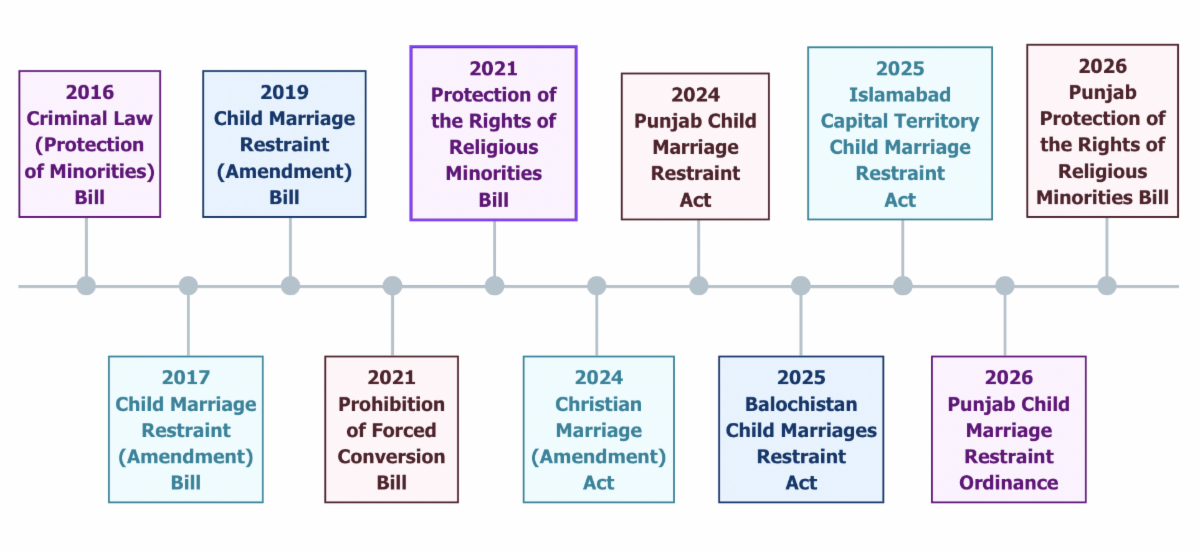
It is, however, not without effort by progressive activists and government members who continuously challenge the status quo, introducing legislations which intend to criminalize child marriage. Regrettably, these common-sense bills are imminently thwarted time and again by radical religio-political entities such as the Council of Islamic Ideology, who claim that setting a minimum age for marriage contravenes Sharia jurisprudence.


Our newest publication, Stolen Girls, hopes to revitalize the discourse on this crisis:

The Numbers


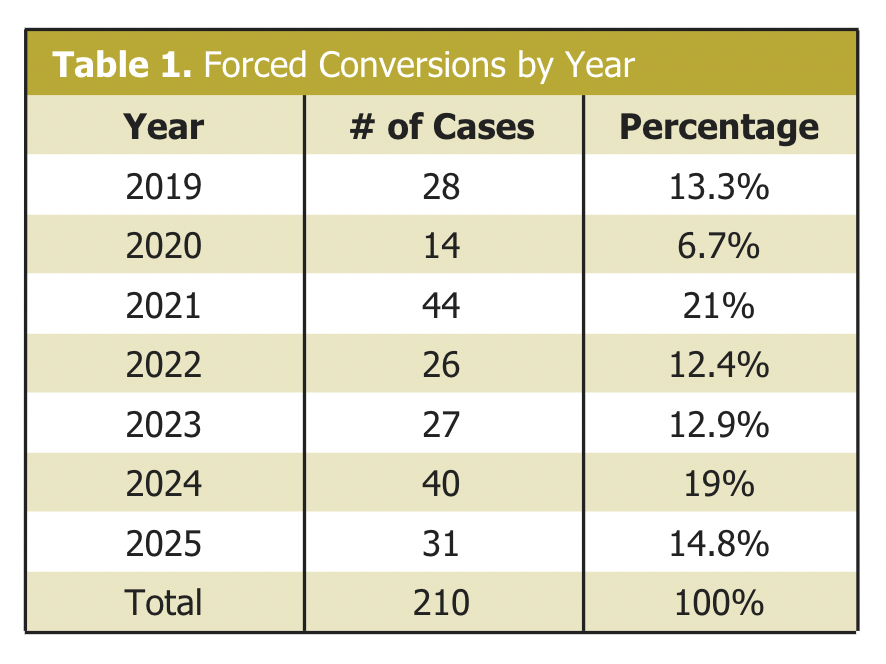
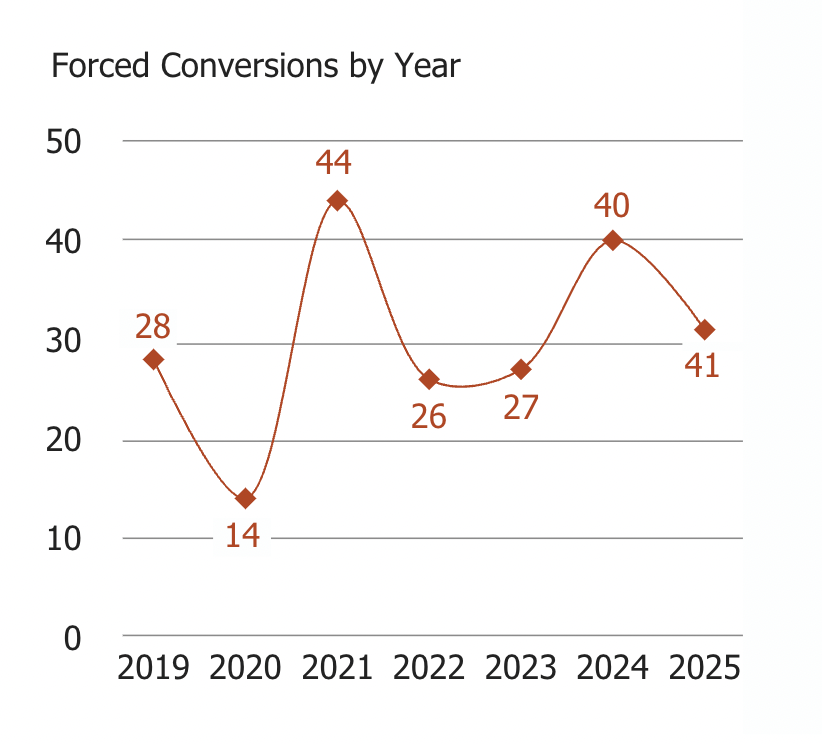
A total of 210 cases related to abduction, coerced religious conversion, and forced marriage involving Christian girls were documented across the country between January 2019 and December 2025. The annual distribution reveals considerable variation in the number of complaints received over the seven years. In 2019, a total of 28 complaints (13.3%) were documented. The number declined significantly to 14 cases (6.7%) in 2020, representing the lowest annual figure during the study period. In 2021, the number of complaints increased sharply to 44 cases (21.0%), the highest annual total in the dataset. The number of documented complaints remained relatively high in the following years, with 26 cases (12.4%) in 2022, 27 cases (12.9%) in 2023, 40 cases (19.0%) in 2024, and 31 cases (14.8%) in 2025. This increase may reflect the improved reporting mechanisms, greater media attention, and intensified monitoring by civil society organizations. The consistently high numbers after 2021 suggest that the phenomenon has remained persistent rather than episodic.

Sindh was the first province to implement its own regional bill on the harmful practice; the 2013 Sindh Child Marriages Restraint Act was unprecedented and predated other regional laws by a decade. In an even more religiously contentious era ten years ago, the legislation withstood opposition from radical Islamic entities and was passed by the Provincial Assembly.


In May 2025, Pakistan’s National Parliament passed the Islamabad Capital Territory Child Marriage Restraint Act, setting 18 as the minimum marriage age for both girls and boys, despite objections from the Council of Islamic Ideology. The bill additionally sets a term of imprisonment not exceeding one year, as well as a fine, for registering nikahs (Islamic marriage contracts) involving spousal parties under the age of majority. Adult males found guilty of marrying minor girls are liable to a maximum three-year prison sentence.


In November 2025, the Balochistan Child Marriages Restraint Act was promulgated, with its clauses modeled after the foregoing Islamabad counterpart. Per this law, any adult man who marries a child under the age of 18, or any individual who “performs, conducts, directs or promotes or abets any child marriage”, can be punished by a term of imprisonment between two and three years, and a mulct amounting to between 100,000 and 200,000 rupees.


In February 2026, the Punjab Child Marriage Restraint Ordinance was enacted forthwith, raising the minimum age of marriage in the province to 18 years irrespective of gender. Bar a few differences in penalty fines prescribed for the crime of marrying a child or solemnizing a child marriage, most of the bill’s provisions align with its counterparts in Islamabad and Balochistan, including classifying underage marriage as a cognizable, non-bailable, and non-compoundable offense. Unsurprisingly, after just a few months in effect, it was challenged by Mufti Muhammad Aslam, who filed a petition at the Federal Shariat Court claiming that “criminalizing marriages involving individuals under the age of 18 was contrary to Islamic teachings”.

The Experts


  • Lazar Allah Rakha: "Legally, the consent or statement of a minor has no evidentiary value. Yet courts often fail to act neutrally and do not assess whether the girl’s statement is free of pressure or intimidation. Orders continue to be issued placing minor girls in the custody of their abductors rather than their parents, based solely on such coerced statements, which amounts to a serious violation of the law." Read Mr. Rakha's full statement


  • Ruth Rukhsana: A bill aimed at criminalizing forced conversion of minority girls was at one point under serious consideration by the government, but it was ultimately rejected. This rejection came under pressure from powerful religious and political actors, including bodies such as the Council of Islamic Ideology and the Ministry of Religious Affairs, who claimed that forced conversions of minorities do not occur in Pakistan. There is still no specific law to address the offence of forced conversions in Pakistan; it has become easier for perpetrators to carry out child marriage and sexual violence with impunity, using religious conversion as a shield against prosecution. Read Ms. Rukhsana's full statement

For more information on Jubilee Campaign's projects, advocacy, and initiatives, please visit our website by clicking the button below.

If you would like to donate to Jubilee Campaign, you may do so by clicking the button below. We thank you in advance for your generous contribution.